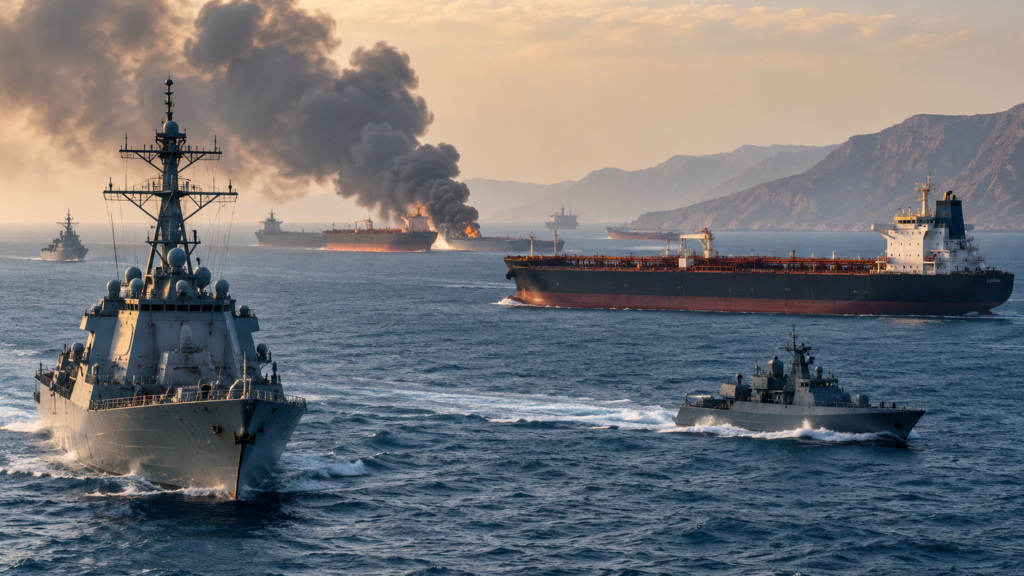
Illustrative image generated for this article.
Tensions between the United States and Iran have risen again around the Strait of Hormuz, one of the most important sea routes in the world. Reuters reported on Monday that both sides had carried out strikes involving ships in and near the strait. The new attacks came after months of conflict and pressure in the region. They quickly caused new worries about energy supplies, shipping safety, and the risk of a wider war. For many people far from the Middle East, this may look like a distant military story. However, the Strait of Hormuz is closely connected to the price of fuel, transport, food, and many other goods around the world.
The Strait of Hormuz is a narrow waterway between Iran and Oman. It connects the Persian Gulf with the Gulf of Oman and the Arabian Sea. A large amount of the world's oil and gas moves through this route every day. Because the sea lane is narrow, ships can have fewer safe choices if fighting increases. Even a short period of danger can make shipping companies change routes, slow down travel, or delay important deliveries. Insurance costs can also rise when companies believe that ships may be attacked. These extra costs can later reach ordinary people through higher prices for fuel and products.
The latest fighting has already affected energy markets. Reuters said Brent crude oil rose to about 97 dollars a barrel early on Monday, while U.S. West Texas Intermediate oil was above 92 dollars. Oil prices can move quickly because traders do not only look at what is happening today. They also try to guess what may happen next. If they believe that oil tankers may not be able to pass safely through the strait, prices can rise before any real shortage appears. This is why news about ships and missiles in the Gulf can have an immediate effect on markets in Asia, Europe, Africa, and the Americas.
Shipping activity has also become an important sign of how serious the situation is. Reuters reported that the average number of commodity ships using the Strait of Hormuz over a recent ten-day period fell to its lowest level since May. This does not mean that the route is completely closed. It does show that companies are becoming more careful. Captains, ship owners, governments, and energy companies must judge the danger before sending vessels through the area. A single attack can affect decisions by many other ships, especially tankers carrying oil, fuel, or chemicals.
The political problem is also difficult. The United States wants to limit Iran's military and economic power, while Iran wants relief from pressure and greater control over decisions that affect its security and trade. At the same time, nearby Gulf countries want to avoid becoming direct battlefields. Oman has often tried to help communication between Iran and the United States. Other countries are also watching closely because they depend on energy from the Gulf. A mistake, a wrong military signal, or an attack that causes many deaths could make talks much harder and lead to more strikes.
For ordinary families around the world, the biggest short-term question may be the price of energy. Higher oil prices can make gasoline, diesel, air travel, and shipping more expensive. Countries that import most of their fuel can be hit especially hard. Businesses may pay more to move goods, and those costs can appear later in shops. Governments may also face pressure to protect consumers or use emergency fuel reserves. The situation can therefore become an economic story as well as a military story.
The next few days will be important. Markets will watch whether more tankers are attacked, whether commercial traffic drops further, and whether diplomats can reduce the tension. Military forces in the area will also try to protect ships while avoiding actions that could start an even larger conflict. For now, the Strait of Hormuz remains open but dangerous. The main lesson is simple: a narrow waterway in the Middle East can influence energy prices and daily life across the entire world. That is why every new development there receives immediate global attention.
02 DISASTER
Nepal Flood Disaster Leaves More Than 1,300 Dead as Thousands Remain Missing
Anak Krakatau Eruption Shuts Seven Indonesian Airports and Disrupts Thousands of Flights

Far-Right AfD Wins Historic Victory in Germany’s Saxony-Anhalt State Election