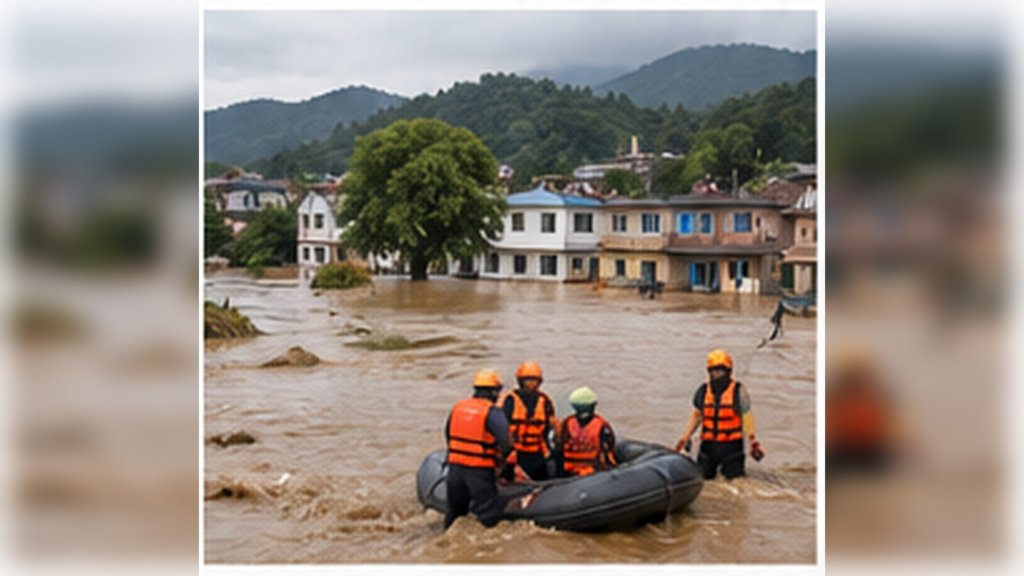
Illustrative image generated for this article.
Rescue teams in Nepal are still searching for thousands of missing people after a huge flood disaster that killed more than 1,300 people. The floods began on August 26 and caused terrible damage in mountain areas, towns, roads, and hydropower sites. Nepal's disaster management agency said more than 5,000 people were still missing. Officials believe the disaster was probably linked to the collapse of a glacier, which sent a large amount of water and debris down narrow valleys. The event has become one of the most serious natural disasters in the region in many years.
The disaster is especially difficult because much of Nepal is mountainous. Roads can be narrow, steep, and easy to block with mud, rocks, or broken bridges. Some villages are far from large hospitals and rescue centers. Helicopters can help, but bad weather and difficult terrain may stop them from flying. Rescue workers often have to move slowly through mud and damaged buildings. In some places, they must use heavy machines to remove large pieces of rock and concrete. In other places, they search by hand because there is no safe road for equipment.
One of the most hopeful stories came ten days after the floods. The Associated Press reported that rescuers pulled a Chinese worker alive from a hydropower tunnel. He had been trapped for many days and was later taken to a hospital in stable condition. A woman was also rescued alive from a damaged house in another area. These rescues gave families hope that more people might still be found. However, rescue teams also know that the chance of survival usually becomes smaller as time passes, especially when people are trapped without clean water, food, or medical care.
Hydropower projects have become a major focus of the search. Authorities said about 900 workers were missing at 12 projects, and around 500 of them were believed to be trapped in different tunnels. Nepal depends heavily on hydropower for electricity, so these projects are often built close to rivers in mountain valleys. That location is useful for producing power, but it can also create danger during extreme floods. Teams from Nepal and several other countries, including India, China, South Korea, and the United States, have joined the rescue effort.
The disaster has also affected families in ways that go beyond the number of deaths. Homes have been destroyed, farms covered with mud, and roads cut off. Some people have lost all their belongings. Others are waiting for news about relatives who worked far from home. Clean water can become difficult to find after floods because rivers and wells may be polluted. Health workers also worry about disease, injuries, and people who cannot reach their normal medicines. Children may lose access to school, and local businesses may remain closed for weeks or months.
Scientists have warned for years that mountain regions can face new risks as the climate becomes warmer. Glaciers can melt faster, and lakes can form behind natural walls of ice or rock. If those walls fail, huge amounts of water can rush downhill very quickly. Not every flood can be blamed on climate change alone, and experts still need to study the exact cause of this event. But Nepal and other Himalayan countries are trying to improve warning systems, maps, and emergency plans for areas that may face sudden floods.
For now, the main work is still rescue and support. Families need food, safe water, shelter, medicine, and information. Roads and communication systems must also be repaired so help can reach isolated areas. The survival of people found many days after the disaster shows why rescue teams continue even when conditions are difficult. At the same time, the very high number of missing people shows the huge scale of the tragedy. Nepal now faces a long recovery, and the world is watching both the human cost and the lessons that can be learned from this disaster.
03 ASIA

U.S.-Iran Strikes Near the Strait of Hormuz Raise New Fears for Global Oil Supplies
Anak Krakatau Eruption Shuts Seven Indonesian Airports and Disrupts Thousands of Flights

Far-Right AfD Wins Historic Victory in Germany’s Saxony-Anhalt State Election