
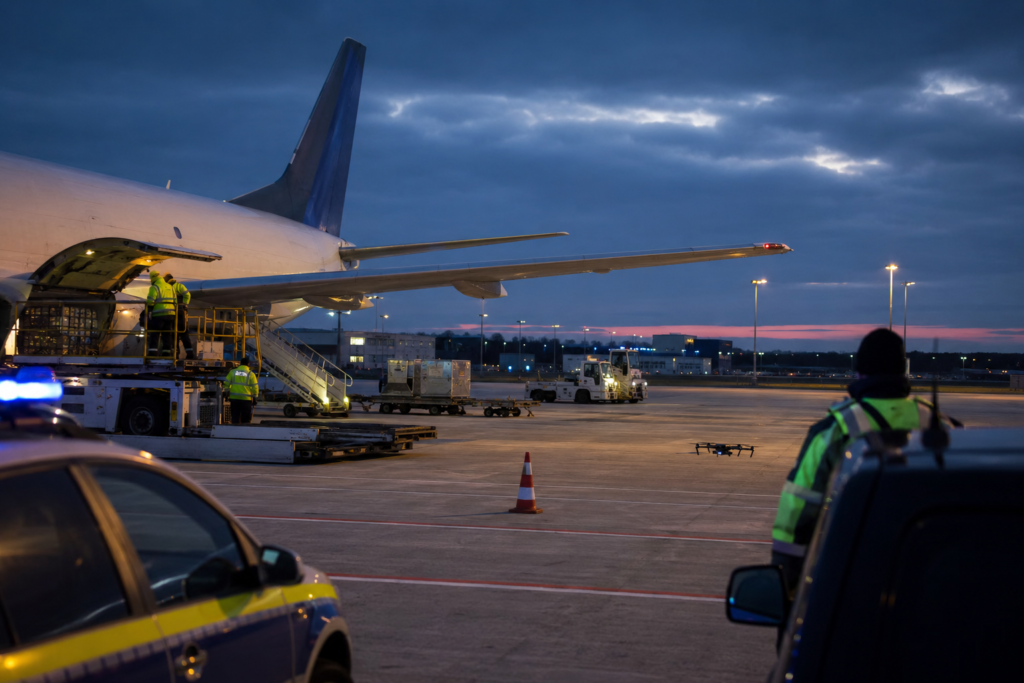
Germany says Russia was behind an attempted attack at Leipzig/Halle Airport; Moscow denies the accusation.
AI-generated editorial illustration created for this article.
European Union leaders are considering stronger action against Russia after Germany blamed Moscow for an attempted drone attack at Leipzig/Halle Airport. German authorities said workers found a drone carrying explosives near a Ukrainian cargo aircraft on August 4. The device was stopped before it could explode, and both airport runways were closed for safety. Leipzig/Halle is an important cargo airport in eastern Germany. It also supports NATO logistics and is used by large Ukrainian transport planes, which may explain why the site was considered a possible target.
Germany said intelligence information showed that people involved in the incident were working for Russian state agencies. The government responded by ordering the closure of a Russian consulate in Bonn and the Russian House cultural center in Berlin. Several European countries also called in Russian diplomats to demand answers. European Commission President Ursula von der Leyen said the event showed growing Russian recklessness and promised more pressure, including possible sanctions. EU officials described the incident as part of a wider pattern of sabotage and other secret actions in Europe.
Russia strongly rejected the German accusation. Moscow called it false and said Germany had created the story to damage relations. Russia then announced that German Goethe-Institut cultural centers in Moscow, St. Petersburg and Yekaterinburg would close. These centers have offered German language classes and cultural programs for many years. The dispute therefore moved beyond security and into education and culture. When governments close cultural institutions, ordinary students and artists can lose opportunities even though they had no part in the political conflict.
The case is an example of what governments call a hybrid threat. A hybrid operation may use drones, cyberattacks, false information, secret agents or damage to important services without an open declaration of war. Such actions are difficult to answer because evidence may be secret and responsibility can be denied. A country must protect its people and infrastructure, but it must also avoid acting too quickly on weak information. Germany says its conclusion is based on intelligence, while Russia says the evidence was invented. The public may not see all the information for security reasons.
EU countries are discussing several possible responses. They may add new sanctions against Russian individuals or organizations, limit visas or close more diplomatic offices. Airports may receive stronger drone-detection equipment and clearer rules for stopping dangerous aircraft. Governments may also share intelligence more quickly. However, each response has costs. Closing consulates makes travel and family services harder. Broad sanctions can affect businesses and citizens. Security measures at airports can slow cargo and passenger travel. Leaders must choose steps that are strong, lawful and focused.
The incident also matters because Europe already feels threatened by the war in Ukraine. Many EU countries send weapons, money and humanitarian help to Ukraine. Russia says this support makes them part of the conflict, while European governments say Ukraine has the right to defend itself. An attack on a European airport, if officially linked to Russia, would increase fears that the conflict is moving beyond Ukraine's borders. NATO countries will want to show unity, but they will also try to avoid a direct military clash with Russia.
Investigators will continue to examine the drone, its explosives, its route and any communication used by the people involved. Clear evidence will be important because the political consequences are already serious. The EU's next steps may include both punishment and better protection of airports, ports, energy networks and computer systems. The case shows that modern security is not only about armies at national borders. A small device at a civilian airport can create a large diplomatic crisis, especially when trust between major powers is already extremely low.
Source used for factual reporting: Reuters. Facts were current on September 3, 2026; developing stories may change.
WORLD NEWS / STORY 05