
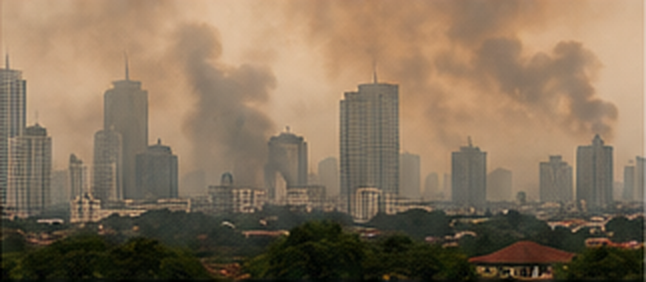
Large forest and peatland fires in Indonesia are sending thick smoke across borders, pushing air quality to dangerous levels in parts of Malaysia and other nearby areas.
AI-generated illustration for this article.
Large wildfires in Indonesia are creating thick smoke that is spreading across the region. Parts of Malaysia have recorded dangerous air quality, and health problems linked to the smoke are increasing. Authorities are also worried that the fires may become harder to control because very dry El Niño weather is expected to be strongest during September.
Many of the fires are burning on the islands of Borneo and Sumatra. These areas contain forests and peatland. Peat is made from old plant material that has built up in wet ground over many years. When peat becomes very dry, it can catch fire and burn slowly underground. These fires are difficult to stop because water may not easily reach the burning material below the surface.
Smoke from the fires can travel hundreds of kilometers. Wind can carry it from Indonesia into Malaysia, Singapore, the Philippines, and other nearby places. This cross-border smoke is often called haze. The sky can look gray or orange, and people may notice a strong smell of smoke even when they are far from the actual fires.
In the Malaysian state of Sarawak on Borneo, air quality reached hazardous levels in several areas. Reports said more people were seeking medical help for breathing problems. Some schools moved lessons online, and outdoor activities were reduced. Authorities advised people to stay indoors when possible, close windows, use air cleaners, and wear suitable masks outside.
Smoke can be especially dangerous for children, older people, pregnant women, and people with asthma or heart and lung problems. However, even healthy adults can feel the effects. Common problems include coughing, sore throats, headaches, eye irritation, and difficulty breathing. When the air is very polluted, spending a long time outside can increase health risks.
Indonesia has sent firefighters, aircraft, and other emergency teams to control the fires. Authorities have also used water bombing, where aircraft drop large amounts of water on burning areas. Another method is weather modification, sometimes called cloud seeding, which tries to increase the chance of rain in suitable conditions.
The weather is making the job harder. A strong El Niño can bring hotter and drier conditions to parts of Southeast Asia. Dry land and lower rainfall make fires easier to start and faster to spread. Indonesia's forestry minister warned that September will be a very difficult month because El Niño is expected to reach its peak.
Officials also say human activity is a major cause of many fires. Land is sometimes burned to clear areas for farming or business because fire can be a cheap and fast way to remove plants. However, when conditions are very dry, a small planned fire can quickly become uncontrolled. The government has investigated companies and individuals connected to high-risk areas and has announced penalties in some cases.
The environmental damage can be very large. Forest fires destroy plants and animal habitats. Peat fires also release large amounts of carbon dioxide and other gases into the atmosphere. This adds to climate change, which can in turn increase the risk of extreme heat and drought in the future.
The economic effects are also serious. Flights can be delayed, tourism can fall, schools and businesses may close, and governments must spend more money on firefighting and health care. Farmers may lose crops, while families may need to buy masks or air cleaners. Because the smoke crosses borders, the problem can also create tension between neighboring countries.
Indonesia has faced severe haze crises before, including a major one in 2015. Governments in the region have tried to improve fire prevention and cooperation since then. However, very dry weather can make even strong prevention systems difficult to manage.
For now, people across affected areas are watching daily air-quality reports. Firefighters are trying to reduce hot spots before they grow, while health authorities are asking the public to protect themselves from the smoke. The crisis is a reminder that wildfires are not only a local problem. When smoke crosses borders, millions of people in several countries can feel the effects.
Fact-checked with Reuters and regional reporting published August 31-September 1, 2026. Article length: 669 words.