
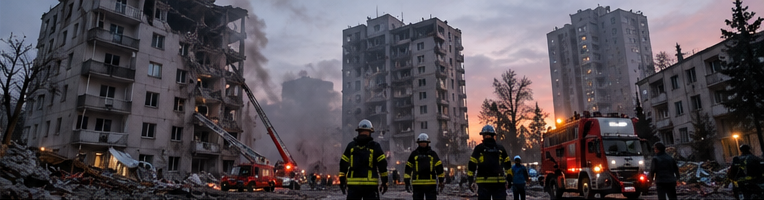
A new attack on the capital
Russia launched a new missile attack on Kyiv early Tuesday, only a short time after U.S. peace envoys left Ukraine. The timing made the attack especially important because Washington is trying to restart talks that could reduce or end the war. Explosions were heard across the Ukrainian capital, and emergency teams worked in several districts after buildings were damaged.
Kyiv officials said ballistic missiles were used in the attack. Residential buildings were hit or damaged by falling debris, and fires broke out in different areas. People were trapped in at least one building. Later reports said there were deaths and injuries. Rescue workers, firefighters, police, and medical teams moved through damaged streets while residents were told to stay in shelters.
The attack came after U.S. envoys Jared Kushner and Steve Witkoff visited the region for talks. They had traveled from Moscow, where they met Russian officials, and then held discussions with Ukrainian President Volodymyr Zelenskiy. The Trump administration has been trying to bring Russia and Ukraine back toward negotiations after years of fighting.
The war began with Russia's full-scale invasion of Ukraine in February 2022. Since then, many Ukrainian cities have suffered repeated missile and drone attacks. Russia says it targets military and transport sites that support Ukraine's armed forces. Ukraine says many attacks also damage homes, schools, hospitals, energy systems, and other civilian buildings.
Why diplomacy is difficult
For people in Kyiv, the sound of air-raid warnings has become part of daily life. Still, every attack brings new fear. Families may spend hours in underground stations, basements, or special shelters. Parents have to decide how to keep children safe. Businesses may close during alerts, and public transport can be interrupted. Even when missiles do not hit a person's home, the stress can continue for a long time.
The latest strike also affected neighboring countries. Poland, which is a member of NATO and the European Union, started military aviation operations as a safety measure. Poland has taken similar steps during previous Russian attacks close to its border. Its main goal is to protect Polish airspace in case a missile or drone moves in the wrong direction.
At the same time, Ukraine continued its own long-range drone attacks inside Russia. Russian regional officials reported damage and injuries in the city of Saratov, an industrial area with an oil refinery and military facilities. Ukraine has increasingly used drones to strike fuel, transport, and military targets that it says support Russia's war effort.
These attacks on both sides show why peace talks are so difficult. Diplomats may discuss a ceasefire in one city while soldiers and commanders continue fighting hundreds of kilometers away. Each side wants security guarantees and political results that the other side may reject. Questions about territory, military forces, sanctions, prisoners, and future relations with Europe remain very hard to solve.
What comes next
The timing of the Kyiv strike will also affect public trust in diplomacy. Ukrainians may ask whether talks can be useful if major attacks continue immediately before or after meetings. Russian officials may argue that military operations will continue until their demands are met. U.S. officials, meanwhile, face the challenge of keeping both sides at the table without appearing to accept attacks on civilians.
Another important issue is air defense. Ukraine has asked Western countries for more systems and interceptor missiles that can stop Russian ballistic missiles and drones. These weapons are expensive, and supplies are limited. When several missiles arrive at the same time, even strong defenses may not stop every one.
The attack also has a wider political meaning. European governments are watching closely because the war affects their security, defense spending, energy policy, and relations with Russia. Any possible peace deal would change the future of Europe. A failed peace effort could lead to more years of fighting and higher costs for both Ukraine and its supporters.
For now, the most important question is whether the latest violence will stop the new diplomatic effort or make governments work harder for a ceasefire. U.S. envoys are expected to continue speaking with both Russian and Ukrainian officials. But events on the ground remain dangerous. As long as missiles, drones, and artillery continue to be used, civilians on both sides will live with uncertainty, and a lasting peace will remain difficult to reach.
Source: Reuters — reporting published September 7–8, 2026.
03 ASIA