
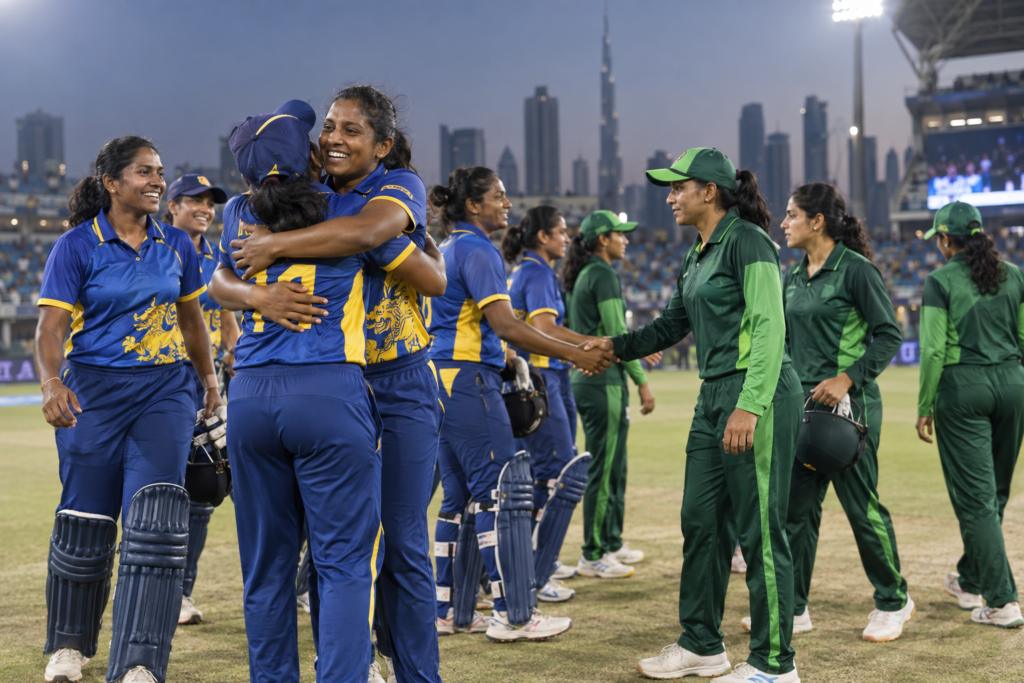
The defending champions recovered from a difficult start and completed a four-wicket victory with eight balls remaining in Dubai.
Sri Lanka's women have reached the Asia Cup final after a tense four-wicket victory over Pakistan in Dubai. Pakistan scored 130 for five in its 20 overs, giving Sri Lanka a target of 131. The chase began badly for the defending champions, but a strong middle-order partnership changed the match. Sri Lanka reached 134 for six in 18.4 overs, winning with eight balls left and earning a place in Sunday's final against India.
Sri Lanka captain Chamari Athapaththu won the toss and chose to bowl first. Her team put Pakistan under pressure early and did not allow the batters to score freely. Pakistan lost wickets at important times and fell to 52 for four. The innings needed a calm leader, and captain Fatima Sana provided one. She stayed unbeaten on 47 from 36 balls and helped her team build a total that gave its bowlers a real chance.
Fatima received useful support near the end of the innings. Pakistan reached 130 for five after 20 overs, a score that was not very high but was competitive on a surface where timing the ball was not always easy. Athapaththu and Chamudi Praboda took two wickets each for Sri Lanka, while Sugandika Kumari took one. Their control meant Pakistan could not create a very large finish.
When Sri Lanka began its chase, Fatima immediately changed the game with the ball. She dismissed Athapaththu and Sanjana Kavindi on two balls in a row. Sri Lanka was suddenly five for two. Hasini Perera also left early, and Imesha Dulani was unable to turn her useful start into a long innings. At 33 for four, Pakistan appeared to be in control and Sri Lanka needed a careful recovery.
Harshitha Samarawickrama and Kavisha Dilhari then built the most important partnership of the match. They added 67 runs for the fifth wicket. Instead of trying to hit every ball to the boundary, they moved the score with singles and twos and punished loose deliveries. Their partnership reduced the required rate and forced Pakistan to search for a new plan. It also showed how calm batting can change a T20 match after several quick wickets.
Fatima returned and removed both players in the same over. Samarawickrama made 36, while Dilhari scored 33. Those wickets gave Pakistan one final hope because two new batters had to finish the chase under pressure. Nilakshika Silva and Kaushani Nuthyangana handled the moment well. Silva finished on 18 not out, and Nuthyangana made 10 not out from four balls. Together, they took Sri Lanka past the target.
Fatima was named player of the match after scoring 47 not out and taking four wickets. It is unusual for the award to go to a player on the losing side, but her all-round performance was clearly outstanding. She kept Pakistan competitive with the bat and nearly won the match with the ball. Her effort also showed that one player can influence many parts of a cricket game even when her team does not get the final result.
Sri Lanka will now face India in the final on September 13. As defending champions, the team has experience in high-pressure matches. However, India will present a different challenge with a deep batting group and several dangerous bowlers. Sri Lanka must avoid another weak start and continue the disciplined bowling that worked against Pakistan. The final will also attract a large audience because matches between leading South Asian teams often create strong regional interest.
For Pakistan, the defeat will be painful because the team came close after creating early pressure. The players can still take positive lessons from Fatima's leadership and the way the bowlers fought. They will also study the 67-run partnership that allowed Sri Lanka to recover. For Sri Lanka, the victory was built on patience, teamwork, and calm decision-making. Those qualities carried the team through a difficult semifinal and gave it another chance to win the Women's Asia Cup.
Sources: International Cricket Council | Asian Cricket Council
06 SPORTS